What We Should Really Worry About with AI
Each wave of progress eliminated some jobs and created new ones.
Railroads reshaped entire economies, putting horse-cart operators out of work. Assembly lines revolutionized manufacturing. We have seen the same with spreadsheets, databases, and the internet.
AI is no different — except it is faster and touches every industry.
As I shared in a recent essay for Built In, this time the context is new. In every past shift, people found a way to retrain, but the process was harder and slower.
Today, the horizons are wider. Anyone with an internet connection can tap into centuries of accumulated knowledge through YouTube, Coursera, Perplexity, and other tools. If you want to reskill, the path is there.
What’s more, some form of universal basic income could ease the transition, and I support this idea.
This is why the debate about “AI taking jobs” feels misplaced to me.
The deeper risk is elsewhere: when AI agents become truly autonomous — capable of self-reasoning, creating sub-agents, and managing resources without humans in the loop.
Alignment and control will determine how this plays out.
Progress will not stop. Our responsibility is to make sure the systems we build remain on our side as progress accelerates.
So I’ll leave you with a question:
What deserves more focus right now — the impact of AI on jobs, the alignment problem, or something else?
Let’s discuss in my recent post on LinkedIn.
Focus Lessons for Building and Scaling
In this section, I’ll share practical advice for founders: how to build and scale startups, think and decide under pressure, and avoid the mistakes I’ve seen founders make along the way.
How to Pick the Right Idea for Your Startup
Selecting a startup idea is as much an emotional process as it is an intellectual one.
Founders who chase market trends without a personal connection tend to quit when they face their first real challenge.
Successful founders build businesses around ideas they cannot stop thinking about.
Andrey Khusid was obsessed with how remote teams could collaborate online. That obsession became Miro.
Songe LaRon and Dave A. Salvant were frustrated by how chaotic barbershop management was. That frustration led them to build SQUIRE.
To help founders decide which idea to pursue, write down five ideas you are considering.
Before validating them, ask yourself:
Would you be happy working on this problem for a decade?
If the answer is no, set the idea aside.
For the rest, rate each idea on two axes:
Excitement
Does the problem genuinely energize you?
Is it something you research in your free time? Do you think about it in the shower or bring it up in unrelated conversations?
Score it from 1 to 5:
1 — Meh
5 — I cannot stop thinking about it
Expertise
Do you bring any unique advantage: domain knowledge, experience, or a relevant network?
Score it from 1 to 5:
1 — I would have to start from scratch
5 — I am already deep in the space
Only the ideas that pass this test deserve your time and effort to validate.
Try it.
Checklist: When to Go Solo vs. Build a Team
For years, I believed in the cliché: two minds are better than one.
Experience, and the AI shift, taught me something different:
The way you work together — or alone — matters more than how many people are involved.
The classic model still holds: one founder drives business, another drives technology. Startups with co-founders have higher success in raising venture capital than solo-led ventures.
However, conflict is the real killer. Roughly 65% of startups fail because co-founders cannot align on vision or resolve disputes.
AI has added nuance.
Solo founders are now on the rise. According to Carta, they made up about 35% of new startups in 2024, up from 17% in 2017.
A solo founder today can go further than ever before.
You do not have to be full-stack. You have to be just fluent enough to identify gaps and build systems around them.
However, the model is not universal.
For SaaS ventures, a solo founder can succeed alone. Deep tech, hardware, or regulated markets still demand broader teams with specialized knowledge.
So, what is the right setup?
Here is a simple framework to help you think it through:
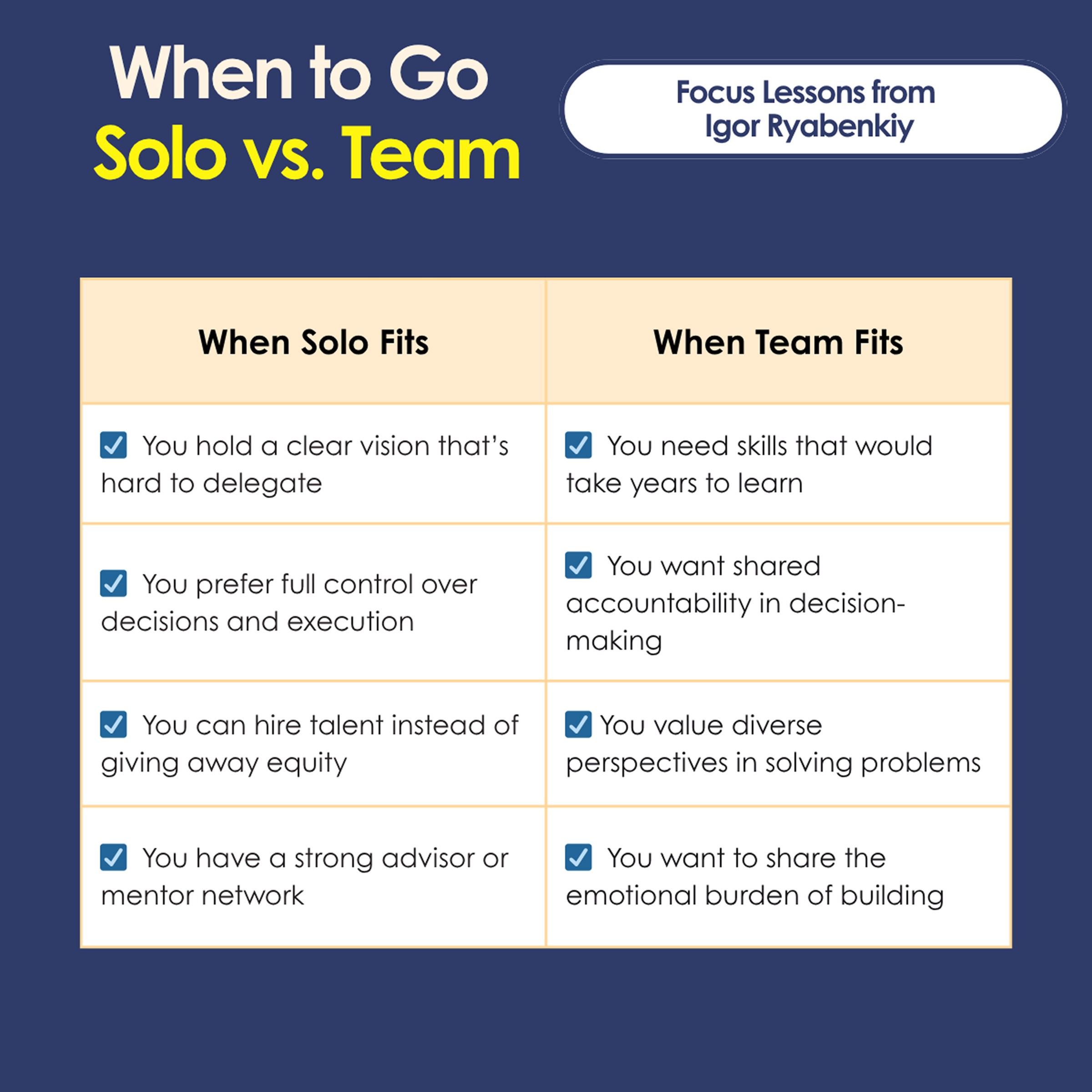
Go solo if:
Your vision is hard to delegate
You want full control
You would rather hire than split equity
You have built a strong mentor network
Build a team if:
You need specialized skills
You want shared accountability
You value diverse perspectives
You do not want to carry the emotional burden alone
My view is that the real question is not team vs. solo.
It is whether your structure helps you scale or slows you down.
These and other practical lessons are included in my Focus Workbook, a hands-on guide to cutting distractions, validating ideas, and executing with clarity.
Inside, you’ll find frameworks, exercises, and templates to help you stay on track.
Download Free Workbook
A Few Trends to Watch
OpenAI Bets on Hiring
OpenAI announced an AI-powered hiring platform to connect employers with job seekers.
This move shows the next phase of the AI race.
Models are commoditizing. Compute is getting cheaper. The real competition is moving to vertical workflows where people actually adopt AI.
OpenAI knows this.
They are expanding into certification, hiring, and training, wrapping workflows around their models. That is how you defend value once the technology itself starts to blur.
That said, this platform probably will not stay inside OpenAI forever.
At scale, hiring and certification are too specialized to remain a side project inside a generalist company.
My bet is that it spins out as a standalone entity, with its own product, team, and mission.
Because experiments can be born inside giants, but true specialization demands focus.
Fewer Deals, Bigger Bets: Is There Still Room for Small Checks?
Do you remember when Facebook hit that eye-watering $10 billion valuation?
At the time, it felt enormous. Today, that is practically pocket change in the startup world.
Median VC deal sizes are climbing, while the number of deals is declining. Capital is concentrating around fewer, bigger bets.
OpenAI raised $40 billion at a $300 billion valuation. Thinking Machines Lab closed a $2 billion seed round at a $12 billion valuation — pre-product.
It is easy to look at numbers like that and wonder:
Is there still a seat at the table for early-stage startups that have not raised billions?
The answer is yes — if you focus on the right things.
Here is what early-stage investors are still looking for:
Products built for real workflows
Especially in vertical SaaS, infrastructure, or underserved industries.
Traditional sectors like healthcare, education, and finance are also emerging as clear winners. These sectors present complex problems with meaningful upside and room for defensible solutions.
Founders with lived experience
Founders who have lived the problem, bring deep insight, and can articulate a focused, compelling vision.
Internal velocity
Speed is one of the few early signals we can rely on.
If a team is slow now, they will not outrun the competition later.
We are still writing early checks.
But the bar is higher, and so is the upside.
Just look at Figma: early backers saw massive returns when the IPO hit. That is what happens when a focused team builds a category leader.