Two Drivers Shaping the AI Economy
As founders start building and scaling, two constraints show up almost immediately: cost and regulation.
Both are easy to underestimate early and hard to fix later.
Here are two shifts worth paying attention to.
Trend #1: The New Layer — Tools That Help Companies Manage AI Costs at Scale
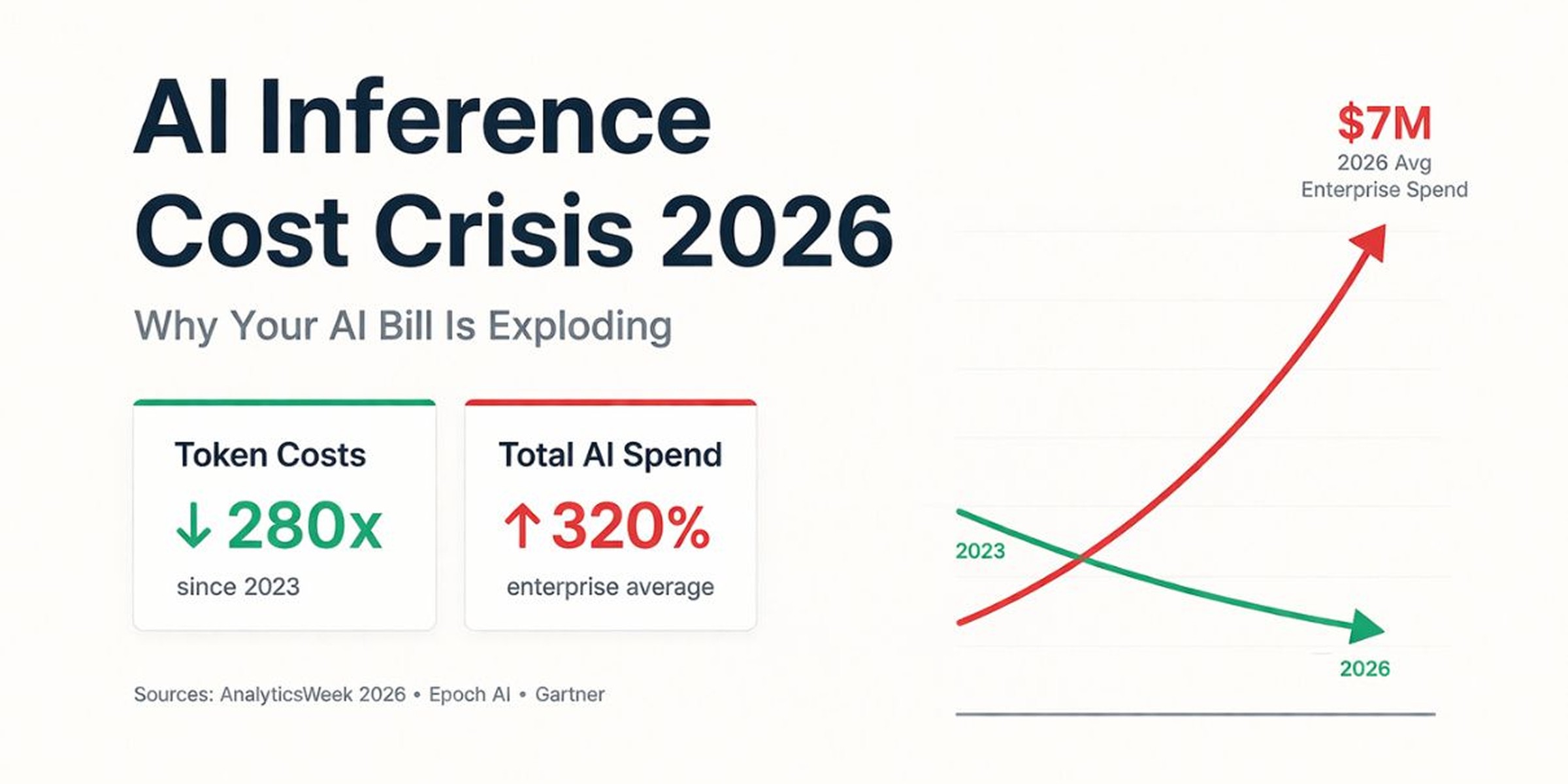
Inference costs have dropped significantly because of better models, better hardware, and more competition.
At the same time, companies are spending more on AI than ever, according to the Oplexa report.
Why?
Because we are moving from simple chatbots to agents and AI workflows.
A chatbot might make one model call. A workflow can trigger dozens: retrieval, reasoning steps, retries, and background jobs.
The more useful AI becomes, the more inference it consumes.
From a startup perspective, this is very important because many AI startups today are built on top of external model APIs — OpenAI, Anthropic, or similar providers.
That means their unit economics depend on inference costs they do not control.
If pricing changes — and it most likely will in the near future — or usage grows faster than expected, margins can disappear very quickly.
So the companies that win will not be the ones with the cheapest model calls.
They will be the ones that:
Minimize tokens per task
Use smaller models where possible
Run inference locally when volume is high
Design workflows efficiently from day one
In other words, inference economics is becoming a core competency.
We are already seeing companies building tools for inference optimization and managing AI costs at scale — and we have invested in some of them.
I think this will become one of the most important metrics in AI businesses over the next few years.
Trend #2: Regulation Is Becoming Part of Product Design
2025 was the first year multiple US states introduced bills explicitly targeting AI chatbots.
In 2026, the wave is widening.
At first glance, these regulations look like a niche rule for “AI companions.”
In reality, this is an early signal that consumer AI product design is becoming a regulatory surface.
Founders building in this space should pay attention.
Here is what the trend means in practice.
Disclosure Becomes a UI Requirement, Not a Legal Footnote
Users need to clearly know they are interacting with AI. This cannot be hidden in the terms of service.
Provenance Tracking Is Becoming Standard Infrastructure
AI-generated content will increasingly require metadata showing where it came from.
Crisis Detection Is Moving From Optional to Expected
Products handling sensitive conversations are expected to detect signals and escalate to human support when needed.
All of these shifts started with large platforms.
Now they are moving into regulation, and smaller startups will face the same bar — from app stores, enterprise customers, and lawmakers.
Regulation raises the floor for product quality.
So build this in now.
By the time it is mandatory, you will already have the trust, the contracts, and the head start.