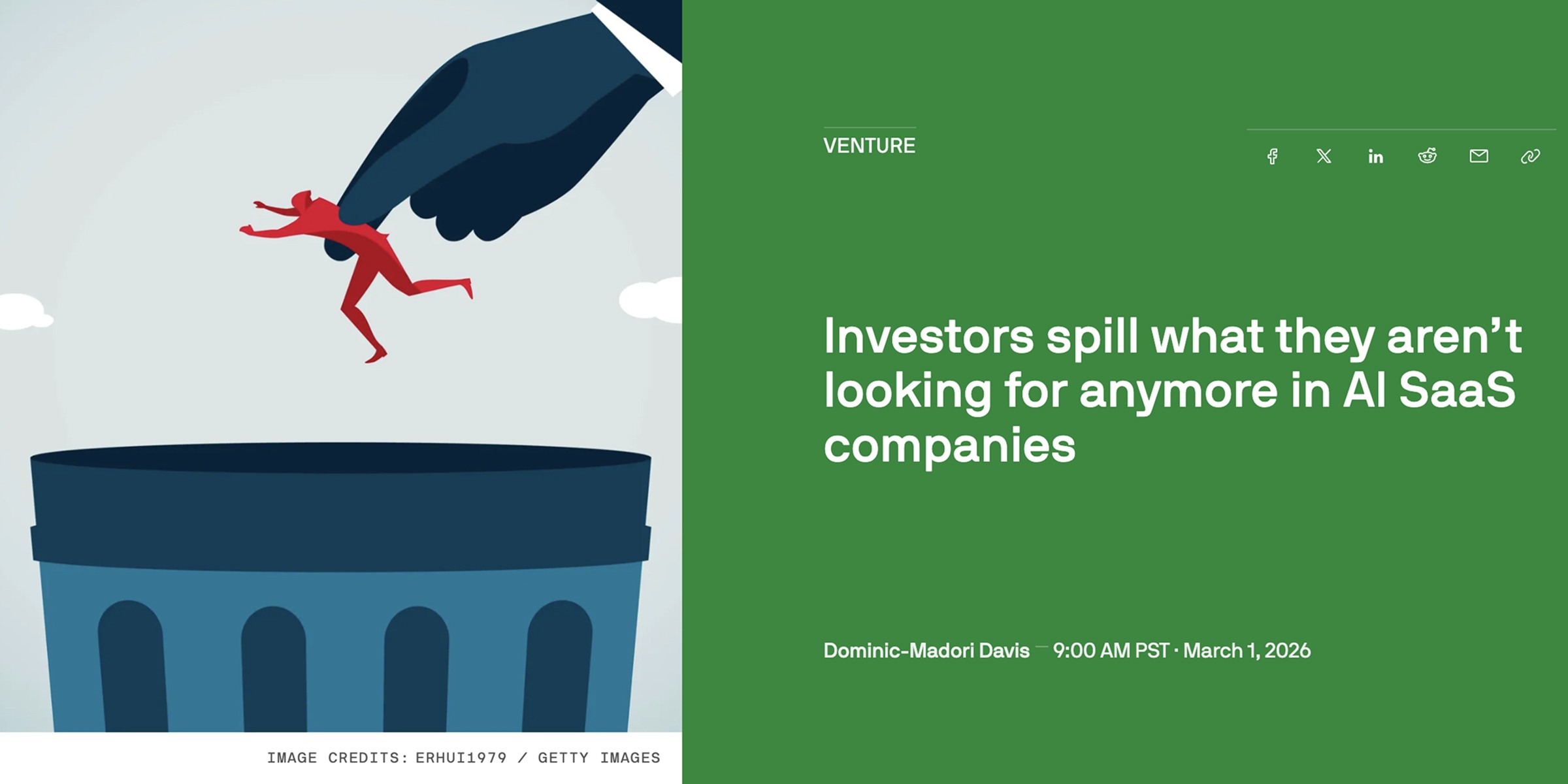
Is SaaS Dead?
Every so often, someone declares SaaS dead.
But the more practical question is:
What are investors actually funding in SaaS today — and what are they avoiding?
I shared my perspective with Dominic-Madori Davis in a recent TechCrunch piece.
If your differentiation lives mostly in UI and automation, that is no longer enough. The barrier to entry has dropped, which makes building a real moat much harder.
That is why generic productivity tools, project management platforms, CRM clones, and thin AI wrappers built on top of existing APIs are finding it harder to raise funding and survive.
So what remains attractive?
Right now, capital is moving toward businesses that control critical workflows, structured data, and real domain expertise — and away from products that can be copied without much effort.
For New Founders
For new founders, this means building around real workflow ownership and a clear understanding of the problem from day one.
Massive codebases are no longer an advantage.
What matters more is speed, focus, and the ability to adapt quickly.
Pricing also needs to be flexible. Rigid per-seat models will be harder to defend, while consumption-based models make more sense in this environment.
We continue to invest in founders building in this new paradigm — welcome to AltaIR Capital and Pre-seed to Succeed.
And through AltaLab, an acceleration program by AltaIR Capital, we work with founders to refine focus, sharpen their vision, and increase their chances of raising capital.
For Existing SaaS Companies
For existing SaaS companies, brand and customer relationships are still strong advantages.
But that is not enough on its own.
They need to adjust how they operate: integrating AI deeply into their products, rethinking internal processes, and updating their marketing strategy and messaging.
The companies that are willing to evolve are continuing to grow.
The ones trying to protect old models will struggle.
This conversation often drifts into:
“SaaS is dead.”
I do not see it that way.
What I see instead is AI raising the bar for SaaS companies.
Read the full article on TechCrunch.
What’s your take: are we watching the end of SaaS, or just its next evolution?
If you have a view on this, feel free to reply to this email and share it.
Focus Lessons for Building and Scaling
In this section, I’m sharing practical advice for founders: how to build and scale startups, think and decide under pressure, and avoid the mistakes I’ve seen founders make along the way.
Same Founder. Same Product. Completely Different Pitch.
I met a founder six months ago and passed on the opportunity.
He pitched his product like this:
“We built an AI tool that drafts contracts.”
I said no.
It did not stand out.
A few months later, the same founder came back.
This time, the pitch sounded very different:
“We work with legal teams to automate repetitive workflows, starting with NDAs, MSAs, and employment agreements, and integrate into their existing workflows and document systems.”
Now it was interesting.
I asked him:
“Weren’t you building a different product when we met last time?”
He replied:
“It’s the same product. I just changed the pitch.”
That is the point.
When a pitch is unclear, the listener fills in the gaps.
And this is not just about pitching to investors. The same applies to customers and even your own team.
The result is predictable:
Either you do not sell at all
Or you sell what they imagined, leaving them disappointed
Or you end up delivering something you never meant to
That is why the second pitch worked.
The product was the same both times.
The difference was that it made the problem, the users, and the workflow immediately clear.